

Offshore software development means hiring a development team in another country, usually where costs are lower, to build or maintain your software. Done well, offshore software development cuts costs by 40 to 70 percent, gives you access to a larger talent pool and lets you scale faster than local hiring allows. Done badly, it leads to missed deadlines and poor code. This guide explains the benefits, the risks and seven smart steps to get it right.
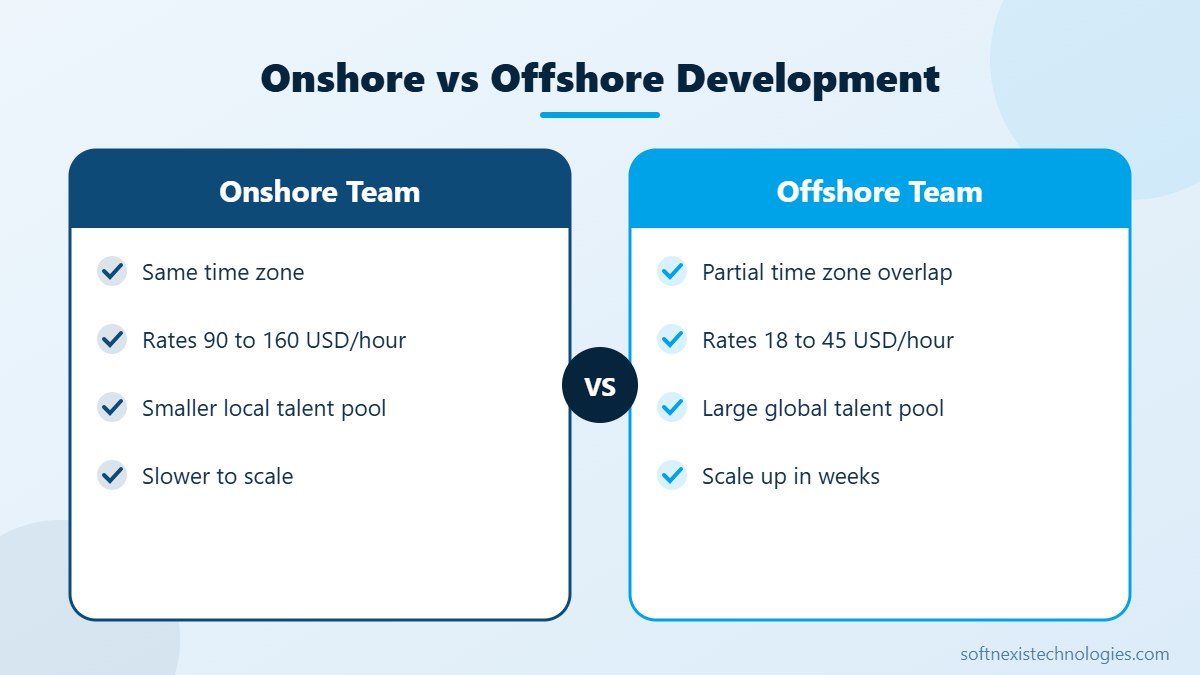
Benefits of offshore software development
- Lower cost. Rates in South Asia and Eastern Europe are a fraction of US and UK rates for similar skills.
- Access to talent. Hire React, Python, AI and DevOps specialists who are hard to find locally.
- Faster scaling. Offshore partners can add developers in weeks, not months.
- Round-the-clock progress. With good planning, work continues while your local team sleeps.
Risks and how to manage them
- Communication gaps: agree on daily overlap hours, one chat channel and weekly demos.
- Quality issues: require code reviews, automated tests and access to the Git repository.
- Hidden costs: confirm what is included, such as project management, QA and support.
- IP and security: sign an NDA and a contract that assigns all code to you.
Offshore software development rates by region (2026)
- Pakistan and India: 18 to 45 USD per hour
- Eastern Europe: 40 to 75 USD per hour
- Latin America: 35 to 70 USD per hour
- Southeast Asia: 20 to 50 USD per hour
See our full guide to remote developer rates for seniority and technology breakdowns.
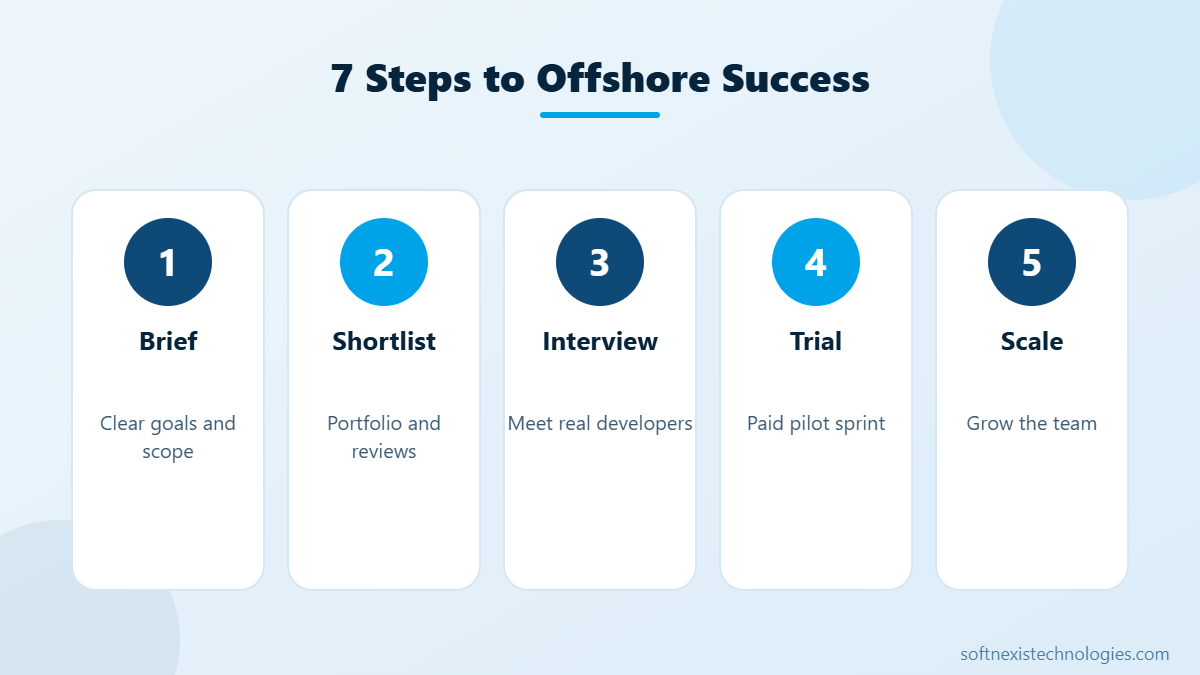
7 smart steps to succeed with offshore software development
- Write a clear brief with goals, users, features and deadlines.
- Choose the engagement model: fixed price, time and materials or a dedicated development team.
- Shortlist partners with live portfolios and verified reviews on Clutch or GoodFirms.
- Interview the developers who will actually work on your project.
- Run a paid trial sprint of two to four weeks.
- Set up the process: sprint planning, demos, task board and shared documentation.
- Review and scale once quality and communication are proven.
Is offshore software development right for you?
It works best for startups and small businesses that need quality software on a limited budget, companies with hiring gaps, and teams that want to scale quickly. If your project needs daily face-to-face workshops or strict local data residency, a nearshore or hybrid team may be better. Compare options in staff augmentation vs outsourcing.
Offshore software development with Softnexis Technologies
Softnexis Technologies is a software house in Pakistan working with clients in the USA, UK, Europe and the Middle East. We build web applications, WordPress and Shopify sites and AI automation, with overlapping hours and weekly demos. Start your project with a free consultation.
Key takeaways: offshore software development
- Offshore software development can cut costs by 40 to 70 percent.
- Success depends on clear briefs, real interviews and a paid trial.
- Daily overlap hours and weekly demos prevent communication gaps.
- Contracts must cover IP ownership, NDA and code access.
The best offshore software development partnerships feel like an extension of your own team. Choose a partner for communication and process as much as for price, and start small so trust and quality can grow together.
Your next step
Pick the two or three actions above that fit your situation, assign an owner and a deadline, and review the results after 30 days. Small, steady improvements add up quickly. If you would rather have experts handle it, the Softnexis Technologies team can audit your current setup, share a clear priority list and implement the changes for you. Talk to our team for a free consultation and a written plan within 24 hours.
Offshore software development: FAQs
How much can I save with offshore development?
Most companies save 40 to 70 percent compared with local agencies, depending on region and seniority.
Which country is best for offshore software development?
Pakistan, India, Eastern Europe and Latin America are popular. Choose based on skills, English level, time zone overlap and budget.
How do I protect my code and data?
Use an NDA, a contract assigning IP to you, your own Git repository and role-based access to systems.
Further reading
Read how to choose a web development company. For background, see offshore outsourcing on Wikipedia.
Featured image by Freepik.