


Staff augmentation vs outsourcing is one of the first decisions you face when your in-house team cannot keep up. Both models give you access to external developers, but they differ in who manages the work, who carries the delivery risk and how you pay. Picking the wrong one can cost months and thousands of dollars. This guide compares the two side by side and gives you a simple way to decide.
What is staff augmentation?
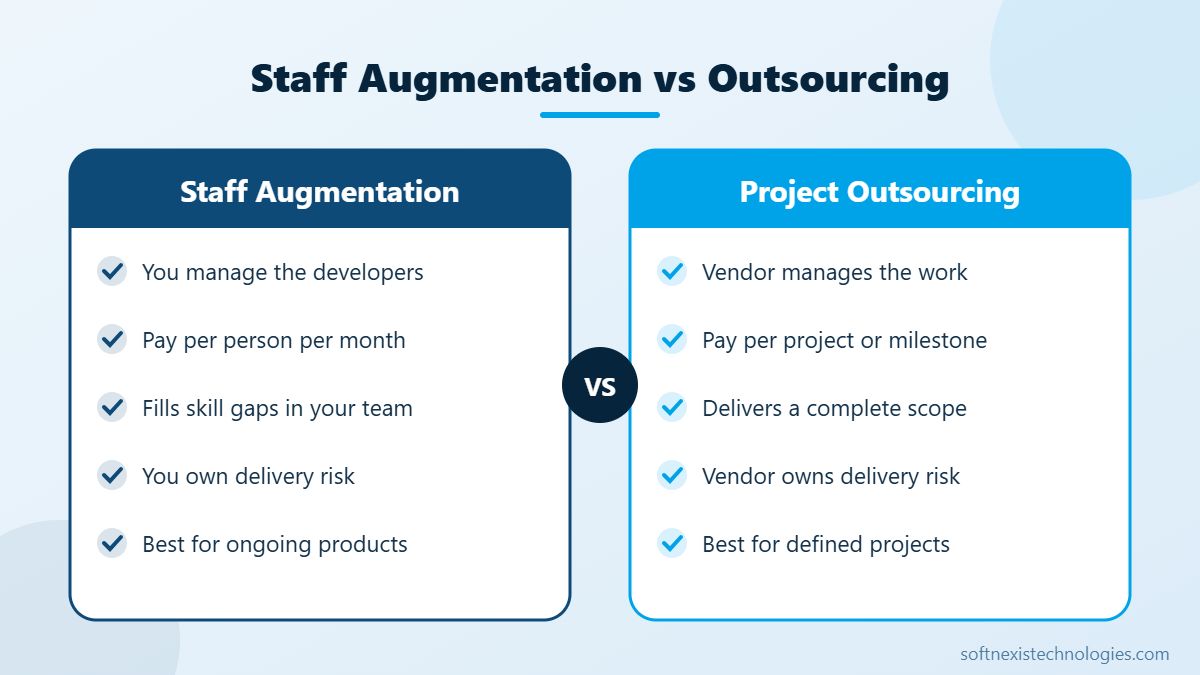
Staff augmentation means adding external developers to your existing team for a period of time. They join your stand-ups, use your tools and follow your technical lead. The vendor handles recruitment, contracts and payroll, but you direct the daily work. It is a quick way to fill a skill gap, such as a React developer or a DevOps engineer, without a long hiring process.
What is project outsourcing?
Project outsourcing means handing a complete piece of work to an external company. You agree on the scope, budget and timeline, and the vendor manages the team, the process and the delivery. You review progress at milestones and accept the final result. This works well when you know exactly what you need, for example a new website, a mobile app MVP or a system integration.
Staff augmentation vs outsourcing: 5 key differences
- Control. With staff augmentation you control priorities and code every day. With outsourcing the vendor controls the how, and you control the what.
- Management effort. Augmented staff need a manager on your side. Outsourced projects need only a product owner who reviews milestones.
- Cost structure. Augmentation is billed per person per month or per hour. Outsourcing is often a fixed price or milestone-based budget.
- Risk. In augmentation you carry the delivery risk. In outsourcing the vendor is responsible for delivering the agreed scope.
- Knowledge retention. Augmented developers build knowledge inside your team. Outsourced projects need good documentation and a clean handover.
When staff augmentation is the better choice
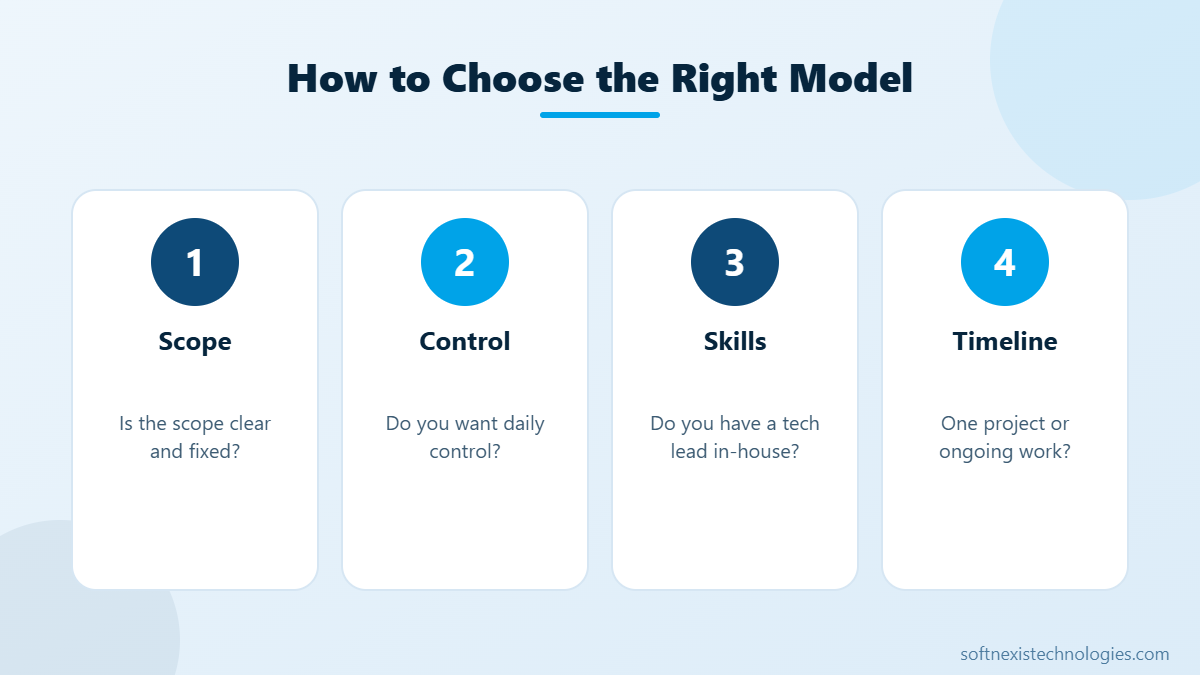
- You already have a technical lead or CTO who can manage developers.
- Your product changes every sprint and the scope cannot be fixed.
- You need one or two specific skills quickly.
- You want developers to learn your codebase for the long term.
When outsourcing is the better choice
- You do not have in-house technical management.
- The project has a clear scope, budget and deadline.
- You want one partner accountable for design, development and testing.
- The work is outside your core business, such as a marketing website or internal tool.
Cost comparison in 2026
A senior augmented developer from South Asia typically costs 2,500 to 4,500 USD per month, compared with 9,000 USD or more in the USA. An outsourced business website or MVP is usually priced per project, from a few thousand dollars for a WordPress site to 25,000 USD or more for a custom web application. When comparing staff augmentation vs outsourcing, always compare the total cost, including your own management time, not only the vendor rate.
The hybrid option: a dedicated team
Many companies combine both approaches. A dedicated development team works full time on your product like augmented staff, but the vendor also provides a project manager, QA and processes like an outsourcing partner. It is a good middle ground for startups that need speed and structure without hiring a full engineering department.
A quick checklist before you decide
- Write down what success looks like in 90 days.
- List the skills you have in-house and the gaps.
- Estimate how much management time you can give each week.
- Ask each vendor for references and a short paid trial.
- Check contracts for IP ownership, notice periods and replacement guarantees.
Softnexis Technologies offers both staff augmentation and full project delivery from Pakistan, with overlapping hours for US, UK and European clients. Tell us about your project on our start your project page and we will recommend the most cost-effective model.
Real-world example: staff augmentation vs outsourcing in practice
Imagine a US logistics company with one in-house developer and a growing backlog. For a new customer portal with a clear scope, outsourcing is the right call: one partner designs, builds and tests it for an agreed budget. For ongoing work on the core dispatch system, staff augmentation fits better: two augmented developers join the existing developer and follow his priorities. Looking at staff augmentation vs outsourcing per project, rather than choosing one model for everything, gives the best balance of cost and control.
Key takeaways
- Staff augmentation vs outsourcing is really a question of who manages the work and who carries the risk.
- Choose augmentation when you have strong technical leadership and changing priorities.
- Choose outsourcing when the scope is clear and you want one accountable partner.
- Many growing companies use both models at the same time for different projects.
Staff augmentation vs outsourcing: FAQs
Is staff augmentation cheaper than outsourcing?
Per hour it can be cheaper, but you also pay with your own management time. For a fixed scope, outsourcing is often more cost-effective overall.
Can I switch from outsourcing to staff augmentation later?
Yes. Many clients start with an outsourced MVP and then keep the same developers as augmented staff for ongoing work.
Which model is better for startups?
Startups without a CTO usually do better with outsourcing or a managed dedicated team, because someone experienced runs the process.
Further reading
See our guide to remote developer rates in 2026 and our software development services. For background on the concept, read staff augmentation on Wikipedia.
Featured image by Freepik.