


Your WordPress website should be your best salesperson. If it is not consistently generating enquiries and leads, the problem is almost always fixable with targeted changes rather than a full rebuild. Here are 12 tactics that reliably generate leads from a WordPress website.
1. Add a Clear Primary CTA on Every Page
Every page should have one primary call to action. Not three options. One. Make it visually prominent, position it above the fold, and use action language: “Get a free quote,” not “Contact us.”
2. Create Dedicated Landing Pages for Each Service
A single services page is a lead killer. Create a separate landing page for each service with a focused headline, bullet points of benefits, social proof, and a form. These pages rank individually on Google and convert far better than generic pages.
3. Install Live Chat or a Chatbot
Visitors who cannot get a quick answer leave. Live chat converts at two to three times the rate of standard contact forms because it meets the visitor at their moment of highest intent. If you cannot staff live chat, an AI chatbot captures leads around the clock.
4. Use Exit Intent Popups
Exit intent technology detects when a visitor is about to leave and shows a targeted offer — a free guide, a discount, or a callback option. Done right, these convert 2–5 percent of otherwise-lost visitors into leads.
5. Add Social Proof Throughout
Case studies, client logos, testimonials with photos, Google review embeds, and before-after project examples all reduce purchase anxiety and increase the likelihood a visitor becomes a lead. Place them near your CTAs, not buried at the bottom of an about page.
6. Optimise Your Contact Form
Reduce your form to the minimum fields needed to qualify a lead. Name, email, and a brief description of the project is usually enough. Every extra field reduces completion rates by 5–10 percent.
Start Your Project with Softnexis
WordPress development and AI automation for businesses worldwide.
Where most WordPress sites lose leads
Most business websites get traffic but fail to generate leads because visitors cannot see a clear next step. The contact page is buried, forms ask for too much, and there is no reason to get in touch today. Fixing these three gaps usually doubles enquiries without spending more on ads.
7 practical ways to generate leads from your website
- One clear offer per page. A free quote, audit or consultation works better than a vague “contact us”.
- Short forms. Name, email, phone and one question. Every extra field lowers conversions.
- Calls to action above the fold. Put a button in the hero and repeat it after each key section.
- Live chat or WhatsApp. Many visitors prefer a quick message to filling in a form.
- Lead magnets. Checklists, price guides and templates capture visitors who are not ready to buy yet.
- Trust signals. Reviews, client logos, case studies and real photos reduce hesitation.
- Fast pages. Every extra second of load time loses visitors before they see your offer.
Connect your forms to a CRM
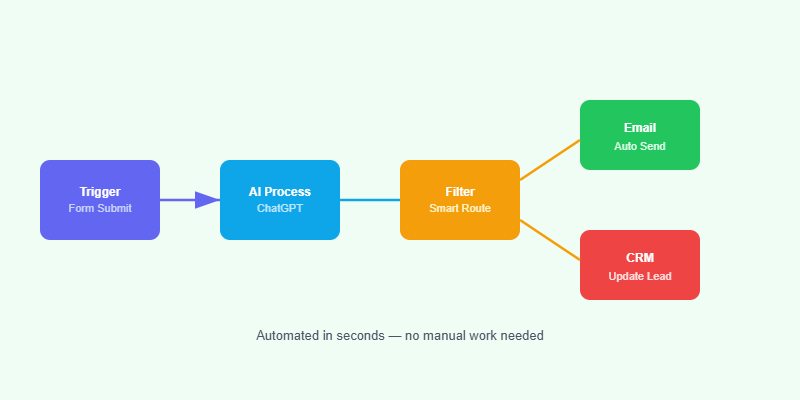
Leads only turn into revenue when someone follows up quickly. Send every form submission to a CRM or a shared inbox, set an automatic reply that confirms receipt, and track the source of each enquiry in Google Analytics. Tools such as Make.com or Zapier can route new leads to email, WhatsApp and your sales pipeline within seconds.
Measure what works
Set up a conversion event for each form, then compare which pages and traffic sources generate leads most often. Improve the weakest pages first. Small changes, like a stronger headline or a shorter form, often produce the biggest gains when you want to generate leads consistently.
Generate leads: frequently asked questions
How many leads should a business website generate?
A typical service site converts 2 to 5 percent of visitors. Clear offers and fast forms help you generate leads at the top of that range.
What is the fastest way to generate leads from a WordPress site?
Add a strong call to action on every page, a short quote form and live chat. These quick changes generate leads within days.
Further reading
For conversion research, see Nielsen Norman Group.