

Gutenberg custom block development lets you add new content types to the WordPress block editor that are perfectly tailored to your theme or client’s needs. Instead of relying on shortcodes or widget hacks, custom blocks give editors a clean, visual interface for structured content.
Custom Block Development Fundamentals
Block Registration
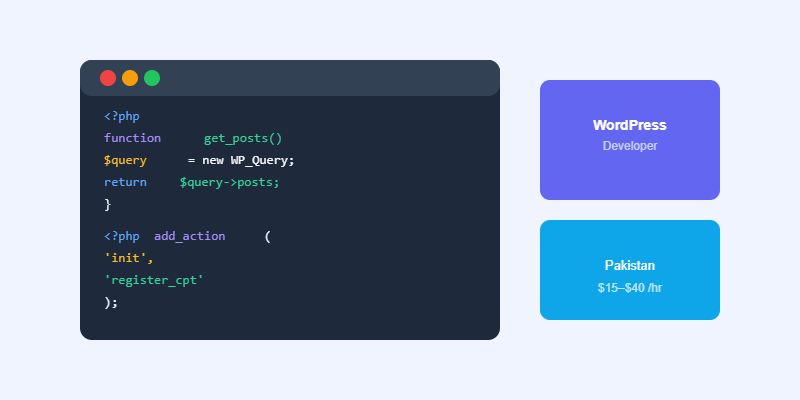
Blocks are registered with register_block_type() in PHP and registerBlockType() in JavaScript. The PHP side registers the block’s name, editor scripts, and render callback (or block.json file). The JavaScript side defines the edit function (what appears in the editor) and the save function (the static HTML saved to the database).
Block Attributes
Attributes are the data fields that store the block’s content and settings — the text a user types, the image they select, the toggle they flip. Declare each attribute in block.json with its type and default value. Access attributes in the edit and save functions via the props object.
Block Controls
InspectorControls (the right sidebar panel), BlockControls (the toolbar above the block), and RichText (the editable text area) are the key React components you will use. Import them from @wordpress/block-editor and build your editing interface with them.
Getting Started with Block Development
Use the @wordpress/create-block package to scaffold a new block plugin in seconds. Run: npx @wordpress/create-block my-block-name. The scaffolded project includes webpack, babel, and all the dependencies you need. Run npm start to watch for changes while you develop.
Start Your Next Web Project
WordPress, WooCommerce and AI automation — professional delivery from Softnexis Technologies.
Gutenberg custom block: frequently asked questions
Do I need React to build a Gutenberg custom block?
Basic React knowledge helps because the editor side of a Gutenberg custom block is written in JavaScript with React components. You can also start with simpler PHP-rendered dynamic blocks.
Is a Gutenberg custom block better than a page builder widget?
A Gutenberg custom block is lighter and faster because it uses the native editor. Page builder widgets are easier to design visually but add more code to every page.
Further reading
Follow the official Block Editor Handbook.