


The WooCommerce vs Shopify question comes down to one fundamental trade-off: control vs convenience. WooCommerce gives you complete ownership and flexibility; Shopify gives you a fully managed platform that handles infrastructure so you can focus on selling. Here is a direct comparison.
WooCommerce vs Shopify: Cost
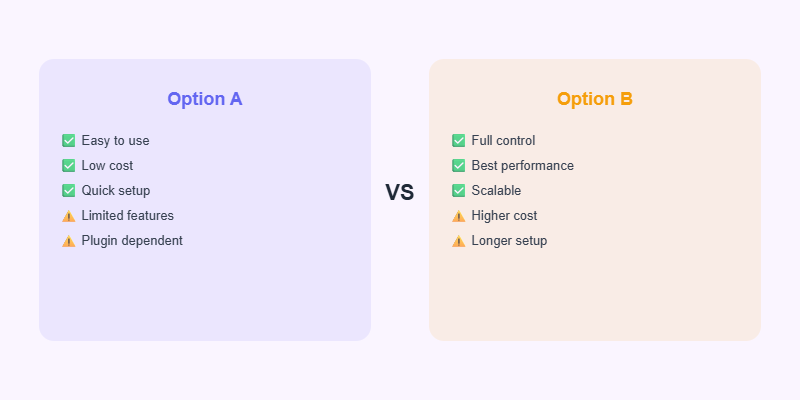
WooCommerce is free to install and runs on hosting you already pay for. The true cost includes hosting (£10–£50/month), premium plugins (£100–£500/year), and development when you need customisations. Shopify starts at $29/month and scales to $299/month for the Advanced plan. Both add up to similar totals for small stores; WooCommerce becomes more cost-effective as the store grows and scales.
Customisation
WooCommerce wins on customisation. You can modify every aspect of the checkout, product pages, and order processing because it runs on your server with full access to the code. Shopify restricts what you can change without their API, and some features require expensive Shopify Plus.
Performance
Shopify’s infrastructure is optimised for e-commerce and handles traffic spikes automatically. WooCommerce performance depends on your hosting — a well-optimised WooCommerce store on managed hosting outperforms Shopify for most stores, but a poorly configured one can be significantly slower.
Verdict
Choose Shopify if you want the fastest path to selling online with minimal technical overhead. Choose WooCommerce if you want full ownership, more flexibility, and plan to invest in your platform long-term.
Ready to Build Something Great?
Softnexis Technologies — WordPress development and AI automation experts.
Cost breakdown: WooCommerce vs Shopify
- WooCommerce: the plugin is free, but you pay for hosting ($10 to $50 a month), a premium theme and paid extensions such as subscriptions or advanced shipping.
- Shopify: plans start around $39 a month and include hosting, security and support. Paid apps and transaction fees on non-Shopify payment gateways add to the cost.
Ease of use
Shopify is easier for beginners: you sign up, pick a theme and start adding products. WooCommerce needs a little more setup, but it runs inside WordPress, so if you already have a WordPress site, your blog, pages and store live in one dashboard.
Flexibility and ownership
WooCommerce gives full control over code, data and hosting, which suits stores with custom pricing rules, B2B features or unusual product types. Shopify is more locked down, but its app store covers most common needs without custom development.
Which should you choose?
Choose Shopify if you want the fastest launch, minimal maintenance and a predictable monthly bill. Choose WooCommerce if content marketing is central to your strategy, you need deep customisation, or you prefer to own every part of the stack. In the WooCommerce vs Shopify decision, there is no single winner: the right platform is the one that matches your budget, skills and growth plans.
WooCommerce vs Shopify: frequently asked questions
Which is cheaper in WooCommerce vs Shopify?
WooCommerce is often cheaper to start because the plugin is free, but hosting and extensions add up. Shopify has a fixed monthly fee that includes hosting and security.
Which is better for SEO, WooCommerce vs Shopify?
Both rank well. In the WooCommerce vs Shopify debate, WooCommerce offers more SEO control, while Shopify is simpler to manage.
Further reading
Compare plans on the Shopify pricing page.