


The web application vs website decision shapes your budget, timeline and the team you hire. Both run in a browser, but they do different jobs. A website mainly shares information and generates leads. A web application lets users log in, enter data and complete tasks. Choosing the wrong one can mean paying for features you do not need, or outgrowing your build within months. Here are six clear differences and a simple way to decide.
What is a website?
A website is a set of pages that presents information: your services, portfolio, blog, contact details and calls to action. Visitors read, browse and contact you. Most business websites run on a CMS like WordPress, so your team can update content without a developer. Interaction is limited to forms, search and perhaps a booking widget.
What is a web application?
A web application is software that runs in the browser. Users sign in, create and edit data, and complete workflows. Gmail, Trello, Canva and online banking are web applications. Business examples include customer portals, booking systems, CRMs, dispatch platforms and SaaS products.
Web application vs website: 6 clear differences
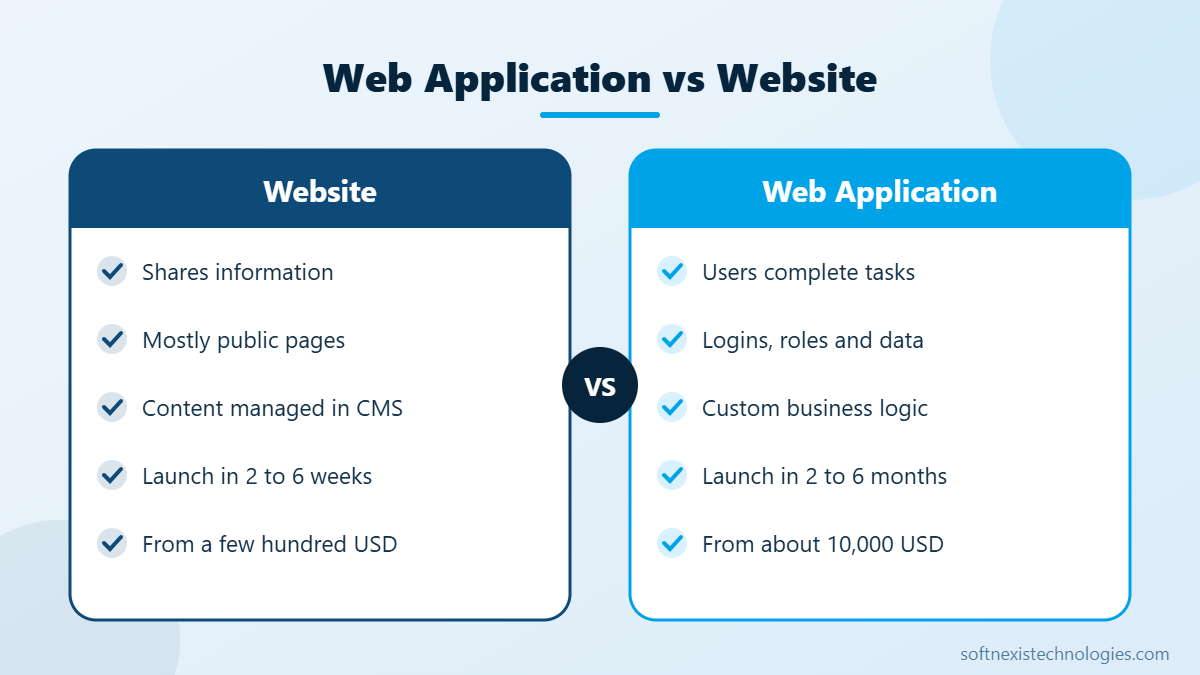
- Purpose. Websites inform and convert visitors into leads. Web applications help users get work done.
- Interaction. Websites are mostly read-only. Web applications are interactive, with dashboards, forms and real-time updates.
- Authentication. Websites are public. Web applications usually require accounts, roles and permissions.
- Technology. Websites often use WordPress, Shopify or static builders. Web applications use frameworks like React, Next.js, Laravel or Node.js with a database and APIs.
- Cost and timeline. A professional business website can launch in two to six weeks. A web application usually takes two to six months.
- Maintenance. Websites need content and security updates. Web applications need ongoing feature work, monitoring, backups and support.
Examples to help you decide
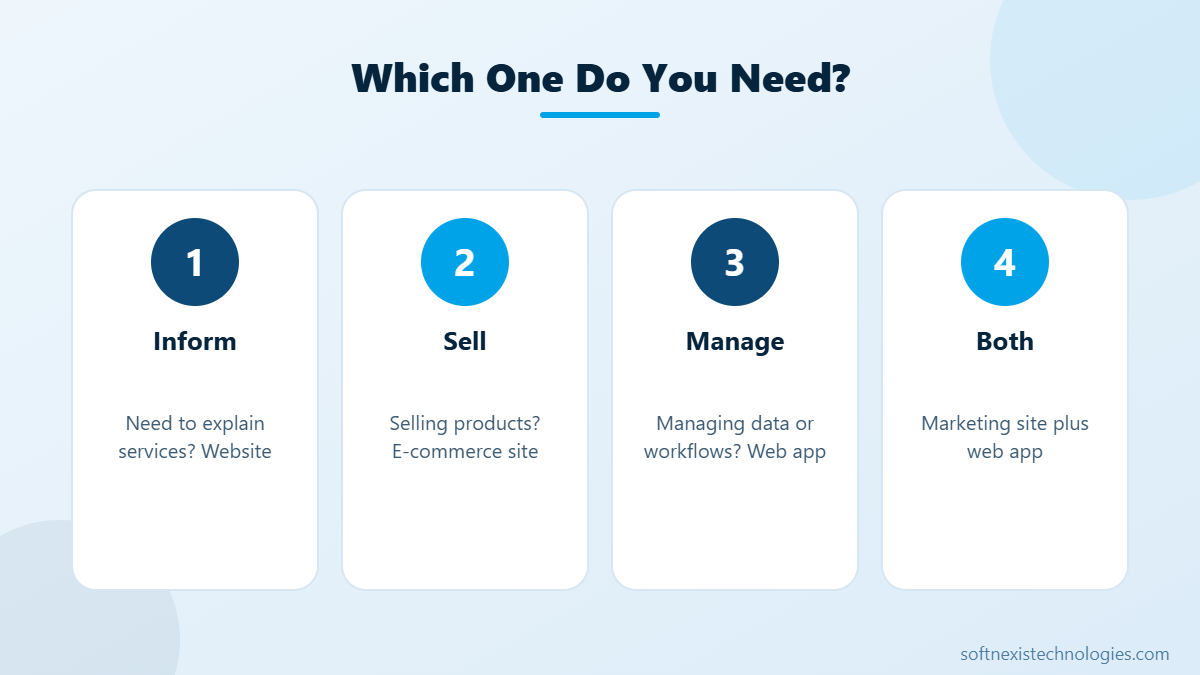
- A dental clinic that wants to show services and take appointment requests needs a website.
- A clothing brand selling online needs an e-commerce website on Shopify or WooCommerce.
- A recruitment agency tracking candidates, interviews and placements needs a web application.
- A SaaS startup needs both: a marketing website to attract users and a web application they log into.
Can a website become a web application?
Yes. Many businesses start with a website, then add a client portal or booking system as they grow. WordPress can handle light application features through plugins and custom development. For complex logic, it is better to build a separate web application and connect it to the website. See WordPress vs custom website for more detail.
Cost comparison
A small business website typically costs 500 to 5,000 USD depending on design and features, as explained in how much a WordPress website costs. A web application usually starts around 10,000 USD and can exceed 100,000 USD for a full SaaS platform. Our custom software development cost guide breaks this down.
Still unsure which you need?
Write down what your users must be able to do. If the list is mostly read, browse and contact, you need a website. If it includes log in, upload, track, approve or pay repeatedly, you need a web application. Softnexis Technologies builds both. Tell us your requirements and we will recommend the right approach for your budget.
Web application vs website: cost and timeline summary
To make the web application vs website choice easier, compare the typical investment side by side. A brochure website with five to ten pages usually launches in two to six weeks. An e-commerce website takes four to ten weeks. A web application with user accounts, dashboards and integrations usually needs two to six months for a first release, followed by continuous improvement. When you weigh web application vs website, also consider maintenance: websites need occasional content and security updates, while web applications need ongoing development, monitoring and support.
Key takeaways
- The web application vs website difference is mostly about interaction: reading versus doing.
- Choose a website to inform, build trust and generate leads.
- Choose a web application when users must log in and complete tasks.
- Many businesses need both, connected through shared branding and data.
Web application vs website: FAQs
Is an e-commerce store a website or a web application?
It is a mix. The storefront works like a website, while the cart, checkout and customer accounts are application features. Platforms like Shopify handle both.
Which is better for SEO?
Websites are usually easier to rank because content is public and crawlable. Web applications rely on a marketing site or public pages for SEO.
Can WordPress be used to build a web application?
For simple portals and membership features, yes. For complex workflows and high traffic, a custom framework is more reliable.
Further reading
Read about MVP development for startups. For a technical definition, see MDN: how the web works.
Featured image by Freepik.