


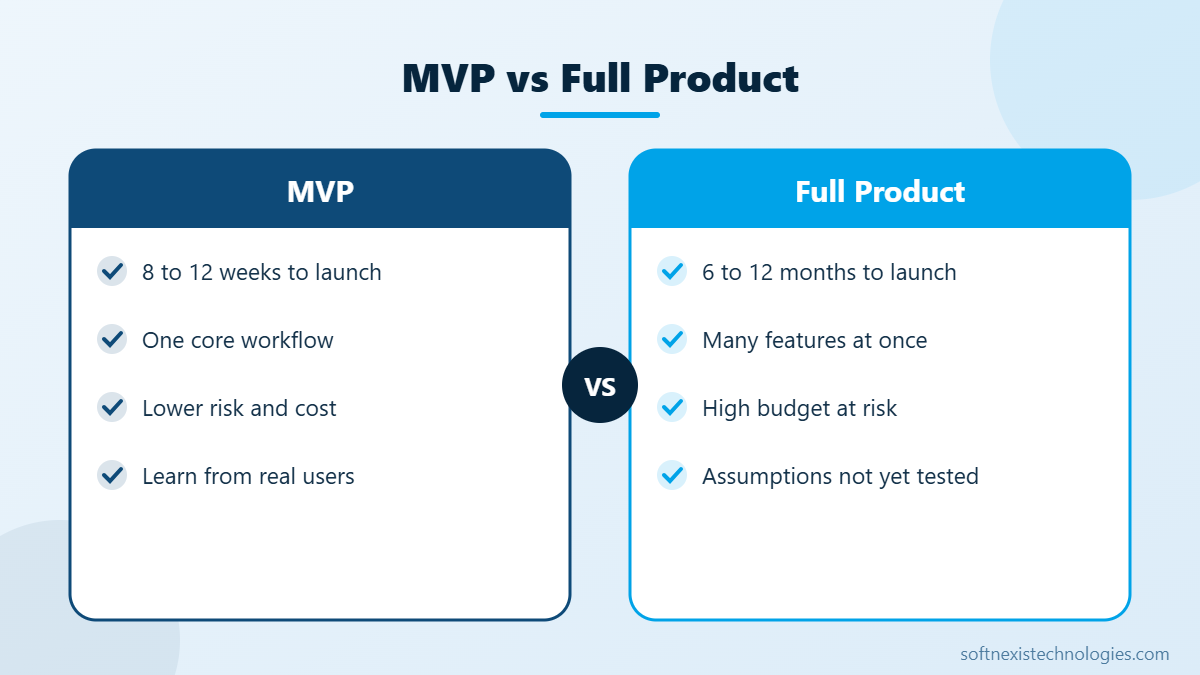
MVP development is the fastest way to test a startup idea with real users before you spend your whole budget. A minimum viable product includes only the features needed to solve one core problem for one group of customers. Done well, MVP development gets you to market in 8 to 12 weeks, gives you real data and makes it far easier to raise funding. Here is the six-step process we follow with founders.
What is an MVP?
An MVP, or minimum viable product, is the simplest version of your product that real customers can use and that proves your main idea. It is not a half-finished app full of bugs. It is a focused, working product with a narrow scope. Dropbox started with a demo video, Airbnb with a basic website listing a few rooms. The goal of MVP development is learning, not perfection.
Why MVP development matters for startups
- Save money. You invest in features users actually want.
- Launch faster. Reach the market before competitors and start building a user base.
- Attract investors. Traction from real users is far more convincing than a pitch deck.
- Reduce risk. If the idea needs to change, you find out early.
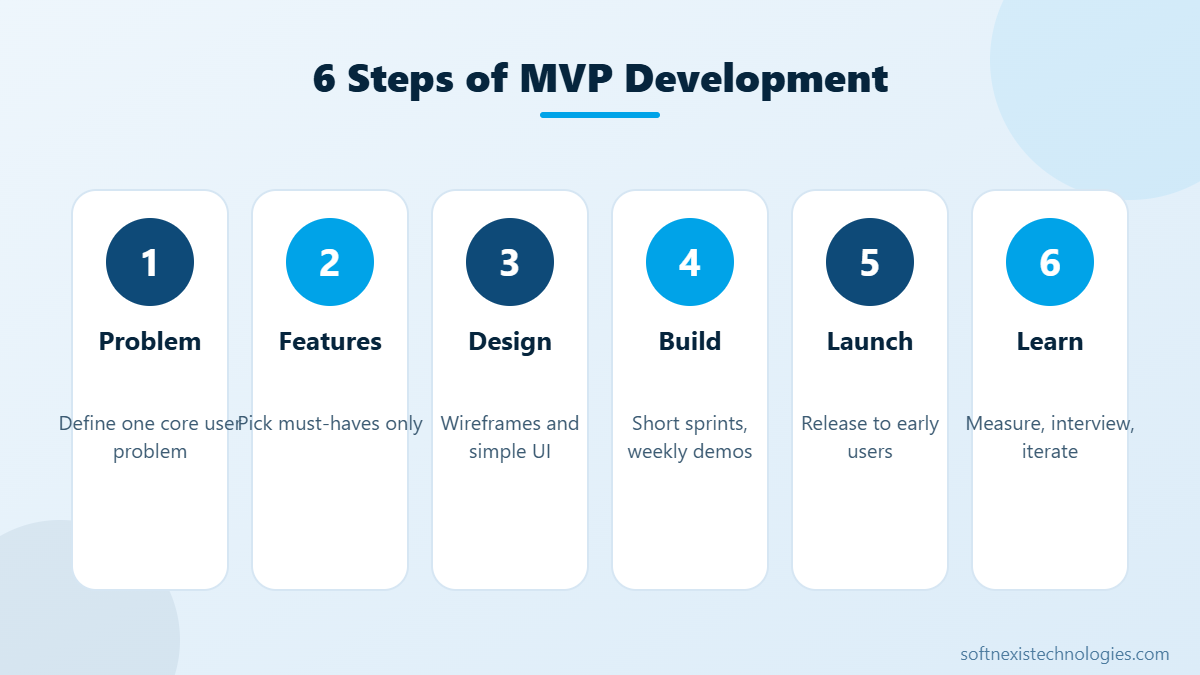
6 simple steps of MVP development
- Define the problem and the user. Write one sentence: who has the problem, what it is and why current solutions fail. Talk to at least ten potential users.
- Choose must-have features. List every feature idea, then keep only those needed to solve the core problem. Everything else goes on a later list.
- Design the user flow. Create simple wireframes for the main journey, from sign-up to the first moment of value.
- Pick a fast, scalable tech stack. For most web MVPs, React or Next.js with Node.js or Laravel, plus managed services like Stripe and Firebase, give speed without locking you in. Sometimes WordPress or Shopify is the fastest route.
- Build in short sprints. Two-week sprints with demos keep the team aligned and let you change direction quickly.
- Launch, measure and learn. Track sign-ups, activation and retention. Interview users every week and plan the next version based on data.
How much does MVP development cost?
With an experienced offshore team, a web MVP usually costs between 8,000 and 30,000 USD and takes 8 to 12 weeks. A mobile MVP for iOS and Android with a shared codebase is typically 15,000 to 45,000 USD. Costs rise with integrations, complex logic and custom design. Our custom software development cost guide explains each factor in detail.
Common MVP development mistakes
- Adding too many features because they seem important.
- Building for everyone instead of one clear customer group.
- Skipping analytics, so you cannot learn from launch.
- Choosing the cheapest freelancer and rebuilding later.
- Waiting for perfection instead of shipping and learning.
No-code or custom code for your MVP?
No-code tools like Bubble or Glide are great for testing demand in days. Custom code is better when your product needs unique logic, performance or ownership of the codebase for investors. Many founders validate with a no-code prototype, then move to custom MVP development once they have paying users.
MVP development with Softnexis Technologies
Softnexis Technologies helps founders turn ideas into working products. Our team in Pakistan handles product scoping, UI/UX, web development, AI features and launch support at startup-friendly rates. You get weekly demos and full ownership of your code. Share your idea and get a scoped MVP plan within 24 hours.
MVP development: frequently asked questions
How long does MVP development take?
Most web MVPs take 8 to 12 weeks from scoping to launch, depending on features and integrations.
What should not be in an MVP?
Nice-to-have features, complex admin panels, multiple user types and heavy custom design can usually wait for later versions.
Can an MVP grow into the full product?
Yes. With a clean, scalable codebase, the MVP becomes the foundation that you extend with each new release.
Further reading
Plan your team with our dedicated development team guide. For the theory behind MVPs, read minimum viable product on Wikipedia.
Featured image by Freepik.