

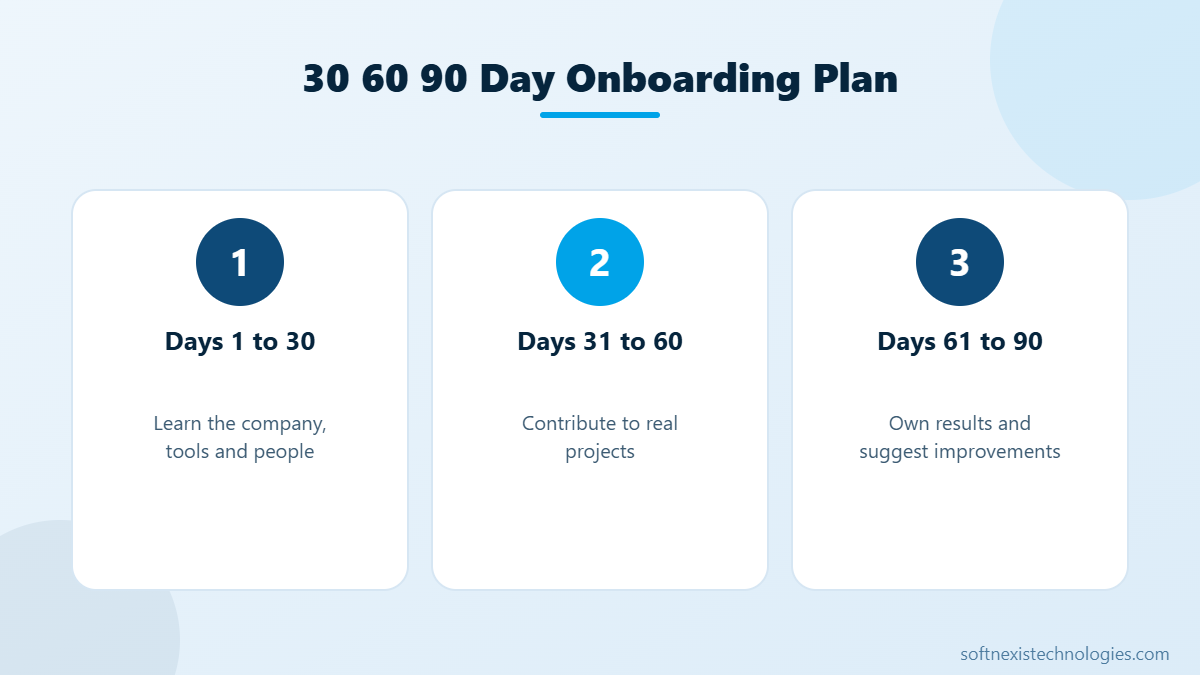
A 30 60 90 day onboarding plan breaks a new employee’s first three months into three clear phases: learn, contribute and lead. Instead of leaving new hires to figure things out alone, it gives them goals, training and check-ins for each stage. Companies with a structured onboarding process keep new hires longer and get them productive sooner. This guide gives you a simple 30 60 90 day onboarding plan template you can adapt for any role.
Before day one: preboarding
- Send a welcome email with start time, dress code and first-day schedule.
- Prepare laptop, accounts, email and system access.
- Assign a buddy who can answer everyday questions.
- Share the 30 60 90 day onboarding plan so the new hire knows what to expect.
Days 1 to 30: learn
The first month is about understanding the company, the team and the role. Goals should focus on learning, not output.
- Meet key colleagues and stakeholders.
- Complete product, process and compliance training.
- Shadow experienced team members.
- Complete one or two small, low-risk tasks.
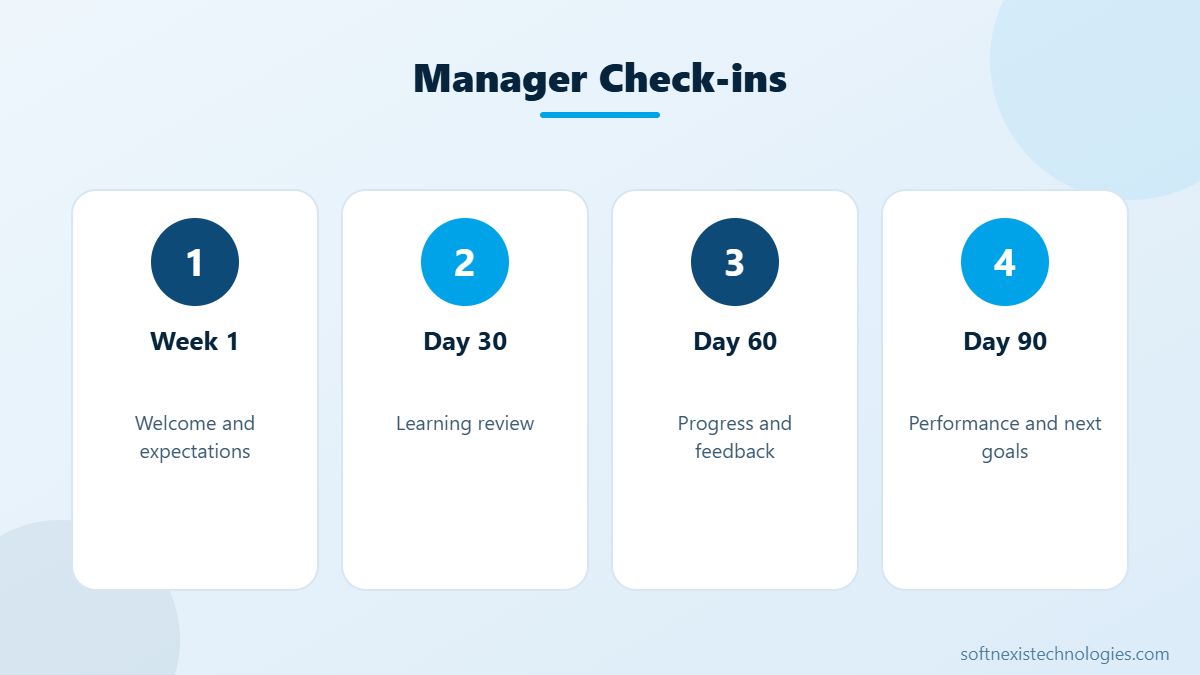
- Day 30 check-in: what is clear, what is confusing, what support is needed.
Days 31 to 60: contribute
In the second month the new hire starts contributing to real work with growing independence.
- Take ownership of defined tasks or a small project.
- Apply training to daily work with less supervision.
- Start building relationships with other departments.
- Day 60 check-in: review progress, give honest feedback and adjust goals.
Days 61 to 90: lead
By the third month the employee should work independently and add ideas of their own.
- Own measurable results, such as targets, deliverables or client accounts.
- Suggest at least one improvement to a process or tool.
- Set goals for the next six months with the manager.
- Day 90 review: confirm the role is a good fit and plan development.
Tips for managers
- Keep the 30 60 90 day onboarding plan written and shared, not only in your head.
- Make goals specific and measurable.
- Hold regular one-to-ones, not only the three formal check-ins.
- Ask for feedback on the onboarding process itself and improve it for the next hire.
Adapting the plan for remote employees
For remote hires, schedule more video calls in the first two weeks, document everything in a shared space and pair them with a buddy in a similar time zone. Remote onboarding works well when expectations and communication channels are clear from day one.
For a full checklist of tasks, see our new hire onboarding checklist. Need help hiring the right people first? Our HR recruitment services handle sourcing, screening and interviews, and we can provide a ready-to-use 30 60 90 day onboarding plan for your roles. Contact us to get started.
Key takeaways: 30 60 90 day onboarding plan
- A 30 60 90 day onboarding plan splits the first three months into learn, contribute and lead.
- Preboarding before day one makes a strong first impression.
- Regular check-ins matter more than a perfect document.
- Collect feedback from every new hire to improve the plan.
A clear 30 60 90 day onboarding plan shows new employees that you are invested in their success. It reduces early turnover, speeds up productivity and gives managers a simple structure for honest conversations.
Your next step
Pick the two or three actions above that fit your situation, assign an owner and a deadline, and review the results after 30 days. Small, steady improvements add up quickly. If you would rather have experts handle it, the Softnexis Technologies team can audit your current setup, share a clear priority list and implement the changes for you. Talk to our team for a free consultation and a written plan within 24 hours.
30 60 90 day onboarding plan: FAQs
What is the purpose of a 30 60 90 day plan?
It gives new employees clear goals and support for their first three months, so they become productive faster and are more likely to stay.
Who creates the onboarding plan?
The hiring manager usually creates it with HR, and the new hire can help refine goals in the first week.
Does the plan work for every role?
Yes. The three phases stay the same, while the specific goals change for sales, technical, operations or management roles.
Further reading
Read how to write a job description and structured interviews. SHRM offers more guidance on employee onboarding.
Featured image by Freepik.